The two smallest tools on the bar do the most work. A jigger sets the ratio of every drink you make, and a bar spoon is how you stir stirred drinks without bruising ice or splashing whiskey down your wrist. Cheap versions of either one will make you a worse home bartender. We have been reviewing bar gear since 2008, and we still keep two jiggers and three bar spoons within reach every time we mix.
Here is what we use, what we recommend, and the ones we finally threw out.
Why the best jigger matters more than the shaker
You can shake a cocktail in a mason jar and it will still taste like the drink. Get the ratio wrong by half an ounce and it will not. A margarita with 2 oz tequila, 1 oz Cointreau, and 1 oz fresh lime is a margarita. Move any of those a quarter ounce and it becomes a different drink, usually a worse one. See our margarita recipe and old fashioned recipe if you want the exact pours we hit every time.
The point of a jigger is not to look cool. It is to remove one variable so the rest of the recipe works. That is why cheap gimmick jiggers, the six-pointed star kind you get in a $12 Amazon kit, are worse than useless. The insides are unmarked and the walls flare, so a “1 oz” pour ranges from about 0.85 to 1.15 depending on your eye.
Even America’s Test Kitchen agrees on this one, and their favorite is not a traditional jigger at all. It is the OXO Good Grips Mini Angled Measuring Cup, a plastic beaker you read from above. We use one at the home bar for anyone learning.
The best jiggers, tested at our bar
OXO SteeL Double Jigger, best overall
The OXO SteeL Double Jigger is what we hand to guests when they want to help. It has a wide, stable base, a rubber waist you can grip with wet hands, and interior lines at 0.25, 0.33, 0.5, 0.75, 1, and 1.5 oz. You can look straight into it and see where you are. The center of gravity is low, so it does not tip when you set it down full. About $10.
Cocktail Kingdom Japanese Style, best precision pour
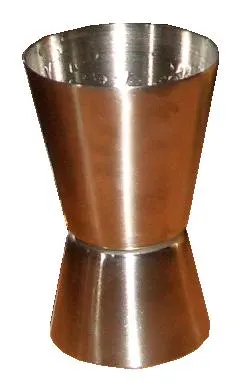
The Cocktail Kingdom Japanese Style Jigger is the one most working bartenders own. Tall and tapered, 1 oz on one end and 2 oz on the other, with etched interior lines at 0.5, 0.75, 1, 1.5, and 2 oz. It is the fastest pour once you know the ratios, because you flip and pour in one wrist motion. The tradeoff: tall means tippy, so respect wet counters. About $12.
OXO SteeL Angled Measuring Jigger, best beginner
The OXO SteeL Angled Measuring Jigger solves the single hardest thing about learning to pour: you can see the line from directly above. No tilt, no squint. 2 oz capacity, ounce and tablespoon markings. If you are the person on the couch reading a cocktail book and thinking “I could do that,” start here.
OXO Good Grips Mini Angled, best budget
Plastic. Dishwasher safe. About $8. The Mini Angled Measuring Cup has milliliter, tablespoon, and ounce lines, and the angled inner wall means you never lift it to check the pour. We keep one at the coffee station too because it doubles as an espresso shot glass.
The best bar spoons, without the mystique
A bar spoon does three things: reach the bottom of a mixing glass, spin cleanly around the inside wall, and give you leverage to layer a float on top. The good ones cost $8 to $15 and last forever. The junk ones bend the first time you press an orange peel.
Barfly Teardrop 30 cm, best overall
The Barfly Teardrop Bar Spoon in 30 cm is the one we reach for. Weighted teardrop end for leverage, twisted stem that spins between your index and middle fingers, and 11.8 inches gets you to the bottom of a standard 500 ml mixing glass. One-piece stainless, no plastic to crack. About $12.
Hiware 12-Inch, Set of 2, best budget
The Hiware set of two is what we buy for holiday hosts and gift baskets. 18/10 stainless, twisted stem, teardrop end, and two of them for what a single Barfly costs. Over 17,000 reviews cannot all be wrong, and ours have taken abuse for years.
Barfly Teardrop 40 cm, for tall pitchers
If you batch cocktails for the whole table in a two-quart pitcher, get the 40 cm Barfly. Same balance, longer reach. Overkill for a mixing glass.
Barfly Bar Spoon with Strainer End, the do-everything
The strainer-end version has a coiled strainer built into the bar spoon. In a small apartment kitchen with no drawer space, this replaces a Hawthorne strainer for stirred drinks. It is not as fine as a real julep strainer, but for a Negroni or a Manhattan, it works.
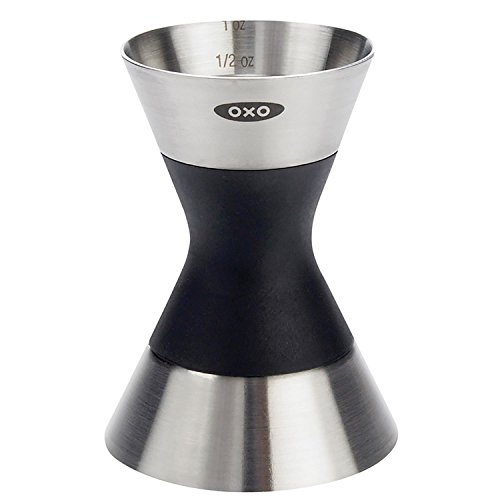 OXO SteeL Double Jigger. Best all-around home jigger. 1 oz / 1.5 oz standard, weighted stainless, clear angled markings so you can pour accurately without lifting to eye level.
 Barfly Teardrop Bar Spoon, 30 cm. The stirring spoon we reach for. Weighted teardrop end, twisted shaft so the spoon spins cleanly in a mixing glass, 30 cm handle sized for most home mixing glasses.
Jigger and bar spoon comparison
| Tool | Style | Best for | Approx price |
|---|---|---|---|
| OXO SteeL Double Jigger | Steel, twin cone with rubber waist | Overall daily use | $10 |
| Cocktail Kingdom Japanese Style | Tall Japanese, etched lines | Precision, working bartenders | $12 |
| OXO SteeL Angled | 2 oz cup, angled interior | Reading pours from above | $12 |
| OXO Mini Angled (plastic) | Plastic beaker, angled | Budget, learners, espresso | $8 |
| Barfly Teardrop 30 cm | Weighted twisted stem | Stirring in a mixing glass | $12 |
| Hiware 12-Inch (set of 2) | Twisted stainless | Budget, gifts | $10 for two |
| Barfly Teardrop 40 cm | Longer weighted twisted stem | Batch pitchers | $14 |
| Barfly Spoon with Strainer | Twisted stem plus coil strainer | Small-kitchen combo tool | $16 |
How we actually use them
Our house workflow at Drink101 has stayed the same since 2008: measure everything, always. Even after 18 years of pouring, we do not eyeball. Free-pouring is fine behind a busy bar where the bartender can taste-check and adjust. At home, with distracted guests and cold hands, it is how you end up with a Manhattan that is 60 percent whiskey.
For a stirred drink, we combine the ingredients in a mixing glass, add ice to the top, and stir clockwise for about 25 seconds. Grip the spoon between index and middle fingers, thumb loose, and let the twisted stem do the work. The teardrop end stays low and traces the inside wall. Done right, the drink chills and dilutes without splashing or bruising. Ice stays whole.
For a shaken drink, we use the same jigger, shake in a Boston tin, and strain. Our cocktail shaker sets guide covers the tins we trust.
What we threw out
We do not keep gear we do not use. These went to the donation box: cheap steel star jiggers with no interior lines, because they are impossible to pour consistently; long copper “bartender kit” bar spoons that bent the first time we tried to muddle a lime with the flat end, because if your spoon has a “muddler” on one end you have neither a good spoon nor a good muddler; and any jigger sold as part of a six-piece “set” of odd ounces with no ratios between. Buy one good tool, not six mediocre ones.
Quick answers
What is the best overall jigger? The OXO SteeL Double Jigger. Wide base, rubber waist, and 1 oz and 1.5 oz sides with interior lines you can read.
What jigger do most bartenders actually use? The Cocktail Kingdom Japanese Style 1 oz and 2 oz. Tall, tapered, with etched lines for 0.5, 0.75, 1, 1.5, and 2 oz.
Is a plastic OXO angled cup okay? Yes. It is our budget pick. The angled interior lets you read the pour from straight above, which is the hard part when you are learning.
What length of bar spoon should I buy? 11 to 12 inches for most mixing glasses. Step up to 15 to 16 inches only if you batch cocktails in tall pitchers.
Weighted or unweighted bar spoon? Weighted. The teardrop or knob on the end gives you leverage and lets the spoon spin between your fingers.
Do I need both a jigger and a measuring cup? No. Pick one style you will actually reach for. Consistency matters more than the shape of the tool.
The two-tool bar
If you take one thing from this piece, take this: a good jigger and a good bar spoon are the highest-leverage $22 you can spend on your home bar. Better than a fancy shaker. Better than expensive glassware. Better than any gadget. Get the OXO SteeL Double Jigger and the Barfly Teardrop 30 cm and your next 100 cocktails will be measurably better than your last 100.
If you want the full home-bar setup, our home bar essentials guide walks through the rest. And if you host guests who are not drinking, our non-alcoholic spirits picks will keep everyone happy. Whatever you pour, pour it like a grown-up: measured, water in between, and always for guests of legal drinking age.
For technique deeper than we can fit here, the Cook’s Illustrated cocktail equipment reviews are a solid third-party benchmark, and the Wikipedia bar spoon entry covers the tool’s history if you like that sort of thing.