Washer toss rules are the shortest rulebook in the backyard: two boxes, six washers, first side to 21. Everything else is house rules and dinner-table arguments. We have been running washer games since 2008, back when we published our washer box build plans with a scrap of PVC and a pile of 2.5 inch flat washers. Here is the full ruleset, the numbers most leagues actually agree on, and the variations worth settling before the first toss.
What do you need to play washer toss?
Two boxes, six washers, and a flat patch of ground. That is the entire equipment list.
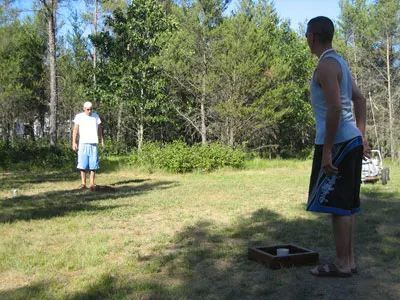
A regulation box is 16 inches wide by 16 inches deep by 4 inches tall, with a 4 inch hole in the center. Standard washers are 2.5 inches in diameter, weigh 2 to 3 ounces, and come in two colors so you can tell whose is whose. Each side gets three washers. Some sets ship with a small piece of rope tied between the two boxes to mark the official distance; if yours does, use it and stop measuring.
The game goes by a lot of names. Washer toss, washers, washer pitching, and Texas horseshoes are the four you will hear most. There are also three-hole board variants (Get Outside Games, Vorticy) that use a flat carpeted board with holes worth 1, 3, and 5 points instead of a cup box. Different game, same crowd. This article covers the classic single-hole box version.
How far apart do the washer toss boxes go?
The Washer Toss Federation puts the official distance at 21 feet, box front to box front. The Canadian 55+ Games rulebook uses 20 feet. The old-school “measure from cup center to cup center” folks call it 25 feet. All three are close enough that “about 21 feet” is what most backyards actually play.
Our house rule since 2008: pace it off once with a tape measure, drop a cooler or a lawn chair to mark each spot, and stop relitigating the distance every round. Kids or a short patio, shorten it to 15 feet. Showoffs, back it up to 25 and watch the washers hop into the flower bed.
What are the official washer toss rules?
The game is played in rounds. Here is the sequence:
- Coin flip or “closest to the hole” toss to decide who pitches first.
- The first player pitches all three washers, one at a time, at the far box. Underhand only. Overhand is legal in a few local leagues, illegal in most, and always looks like you are trying too hard.
- The second player then pitches their three washers at the same box.
- When all six washers are thrown, the round is over. Score only washers that came to rest in or on the box.
- Winner of the round pitches first in the next round.
Doubles is the more common format. Two players per side, partners stand at opposite boxes, and nobody has to walk anywhere between rounds. Singles works fine, it just means you play the round, walk 21 feet, play the next round, walk back. Doubles is objectively the right choice on a hot day.
Knocking your opponent’s washers off is legal and encouraged. A washer that gets knocked out of or off the box before the round ends scores nothing. This is half the fun of the game and roughly half the arguments.
How does washer toss scoring work?
Points depend on where each washer comes to rest at the end of the round:
| Landing spot | Points | Notes |
|---|---|---|
| In the hole | 3 | Also called a “cupper” or “ringer” |
| On the box (not in hole) | 1 | Any part of the washer touching the box top counts |
| Leaning against the box from the ground | 0 | Has to be on the box, not resting against it |
| Anywhere else | 0 | Grass, dirt, cooler, dog |
Most leagues use cancellation scoring, same as cornhole. Add up each side’s total for the round, subtract the lower total from the higher one, and only the higher side scores the difference. Example: your team lands one in the hole and one on the box for 4 points. The other side lands two on the box for 2 points. You scored 4, they scored 2, so cancellation nets you 2 points for the round.
Traditional (non-cancellation) scoring exists too. Every washer scores for whoever threw it, and the round total for each side just gets added to the running score. Faster to teach, longer to finish, and it turns close games into blowouts. Cancellation is the default we run.
What is the winning score and the “must land on 21” rule?
First side to exactly 21 points wins. Some leagues play “first to 21 or more,” but the classic version requires an exact 21.
Here is the twist that catches new players every time: if you go over 21, your score for that round gets reversed off your total. Example: you are sitting on 19, you land a 3 in the hole, and your net for the round would push you to 22. That 3 comes back off, so you stay at 19 and try again next round. Some houses call this “busting”; others call it “washing out.” Either way, the effect is the same. Playing for exactly 21 turns the endgame into a chess match where you would rather land a 1 than a 3.
If you want a faster game, drop the “must land on 21” rule and play first to 21 or more. This is the version most casual barbecues run because nobody wants to be sitting on 19 for six straight rounds while the burgers go cold.
 Driveway Games All Weather Washoos Washer Toss Set. is the easiest starter kit: two tournament-size targets, six steel washers, a carry handle, and a metal latch that keeps the washers from ending up under the couch. It is the "throw it in the trunk on Friday" pick.
- Stepping the line. Foot past the front edge of the box on release, toss does not count.
- Throwing overhand in a league that says underhand. Check your ruleset before the first game.
- Wrong-color washers. Each side pitches matching washers. Mixed sets get confusing after the third round.
- Pitching out of turn. Sounds obvious, still happens once per barbecue.
A washer that goes in on a bounce, off another washer, or off the rim of the hole is legal in official play. If you want a purist version, house rule that only clean, direct-hole shots count as 3 and bounced-ins count as 1. Decide before the first pitch, not after the game-winning ricochet.
What gear do you actually need for a good set?
There are three tiers, and the jump from tier 1 to tier 2 is real. Tier 2 to tier 3 mostly buys you looks.
| Setup level | What you get | Rough cost |
|---|---|---|
| Backyard casual | Plastic or particleboard boxes, painted steel washers | $25 to $45 |
| Regulation wood set | Solid pine or plywood boxes, powder-coated 2.5” washers, carry latch | $60 to $110 |
| Three-hole board sets | Carpeted plywood boards, custom washers, tournament graphics | $120 to $250 |
 Patriotic Washer Toss Game Set. use full 1 inch baltic birch, indoor/outdoor carpet, and rope carry handles. Different game from classic box washers, worth a look if your crew wants more scoring surface and less "did that count" arguing about washers leaning on the box.
Most backyard groups run close to official rules with a couple of tweaks:
- Drop the exact-21 rule for casual games. Play first to 21 or more. Games finish in 15 minutes instead of 45.
- Overhand allowed after round 5. If nobody has scored, loosen it up so the game does not stall.
- Blockers count. A washer sitting on the box lip can knock your opponent’s cupper offline. Official rules allow this. Some casual groups ban it because it slows the game down. Your call.
- Walk-up rule. In singles, the losing side of the round walks to fetch and pitch first from the other end. Keeps things fair and gets a few extra steps in.
The quick answers
- Distance between boxes: 21 feet, front edge to front edge (20 in some rulebooks)
- Box size: 16 inches wide, 16 inches deep, 4 inches tall
- Hole size: 4 inches in diameter, centered on the top of the box
- Washer spec: 2.5 inches in diameter, 2 to 3 ounces, three per side
- Scoring: 3 points in the hole, 1 point on the box, cancellation format
- Winning score: exactly 21 (traditional) or first to 21+ (casual)
- Bust rule: going over 21 reverses the round score off your total
That covers the official washer toss rules for distance, boxes, and scoring, plus the house calls worth settling before the first washer flies. If washer toss is the appetizer, get the main event running with our cornhole rules or round out the backyard rotation with ladder golf rules and a game of flip cup after dinner.