We have been setting up boards in backyards and parking lots since 2008, and cornhole rules are still the thing people argue about most at the cookout. Not the beer, not the music, the rules. So here is the official version from the American Cornhole League and American Cornhole Association, plus the house-rule variations that are actually worth keeping.
What are the official cornhole rules for board distance?
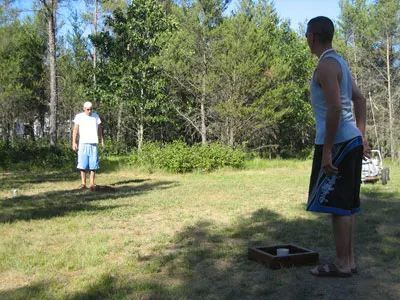
27 feet, measured from the front edge of one board to the front edge of the other. That is the number the American Cornhole League and the American Cornhole Association both use for adult play. For kids 12 and under, most leagues shorten it to 12 to 15 feet so the game does not turn into a 40-minute air-mail contest.
Get the distance close. A few inches off will not ruin your barbecue, but if you are setting lines for a tournament bracket, the ACL tolerance is 27 feet plus or minus a half inch, board to board.
What are the official board dimensions?
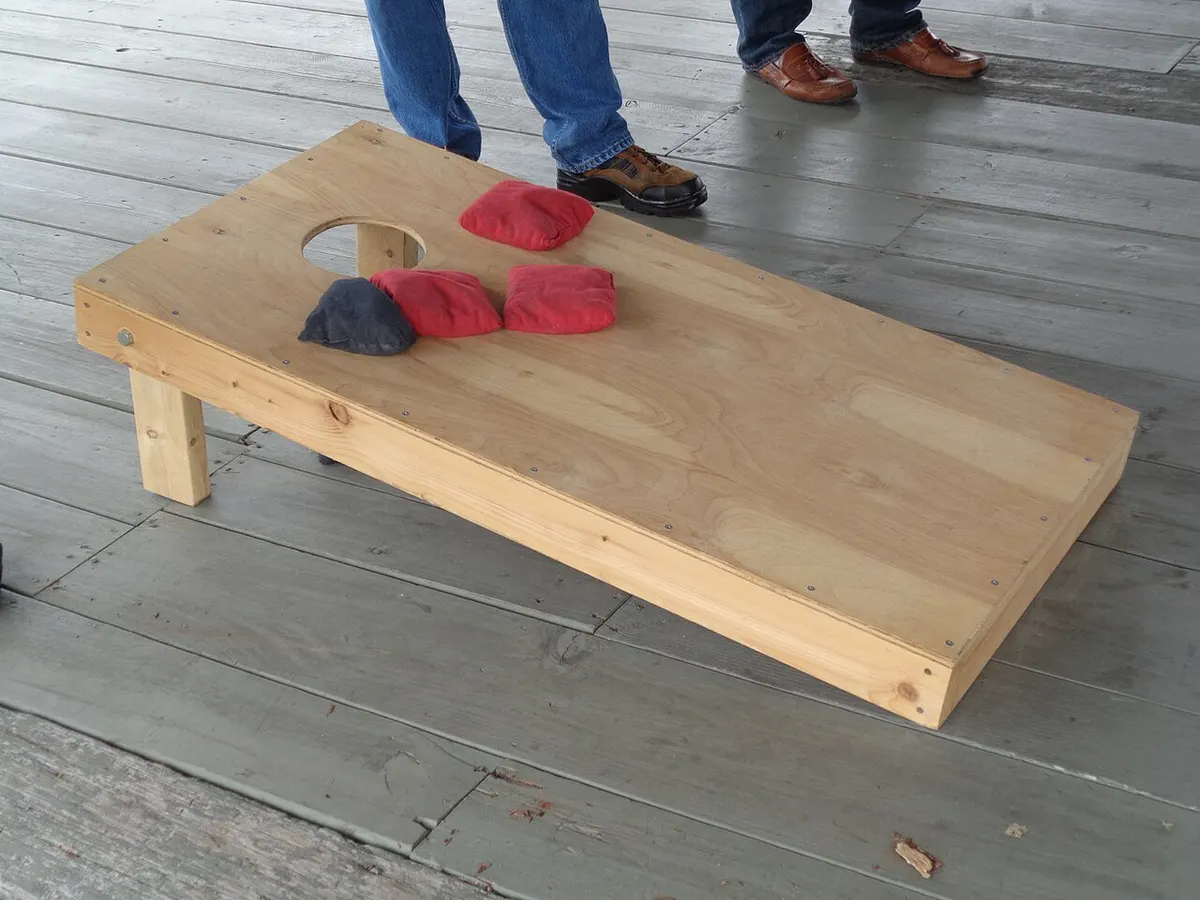
A regulation board is 2 feet wide by 4 feet long, built from plywood at least a half inch thick, with a quarter-inch tolerance on those dimensions. The hole is 6 inches in diameter, centered left to right, with its center 9 inches from the back edge of the board. The back edge sits 12 inches off the ground, which puts the playing surface at roughly a 10-degree angle.
| Spec | Regulation measurement |
|---|---|
| Board size | 24” wide x 48” long |
| Board thickness | 1/2” plywood minimum |
| Hole diameter | 6”, centered |
| Hole position | 9” from back edge |
| Back height | 12” off ground |
| Distance between boards | 27” ft (front edge to front edge) |
| Pitcher’s box | 4’ deep x 3’ wide, both sides of each board |
| Bag size / weight | 6” x 6”, 15 to 16 oz |
How does cornhole scoring work?
Cornhole uses cancellation scoring. Here is the plain-English version: each round, both players or teams throw four bags at the same board. A bag on the board scores 1 point, a bag through the hole scores 3 points. Add up each side’s total for the round, then subtract the lower total from the higher one. Only the side with the higher total scores, and only the difference counts.
Example: your team lands two bags on the board and one through the hole for 5 points. The other side lands one bag on the board for 1 point. You scored 5, they scored 1, so cancellation nets you 4 points for the round.
First side to 21 points or more wins the game outright, no requirement to win by 2. Some house leagues play to 15 for faster turnover on a crowded patio, which is fine as long as everyone agrees before the first bag flies.
What counts as a foul?
- Stepping the line. Your front foot has to stay inside the 4-foot by 3-foot pitcher’s box while you release the bag. Step past the front edge and the throw does not count, even if it goes in.
- Wrong bag color. Everyone on a side throws matching bags. Mixed sets get confusing fast and are technically a foul in sanctioned play.
- Throwing out of turn. Sounds obvious, still happens after the third beer.
“Airmail” is not a foul, it is a flex: a bag that goes straight through the hole without ever touching the board. Still worth 3 points, just extra satisfying to land.
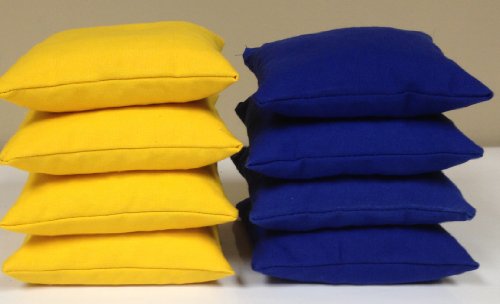 ACA regulation cornhole bags. For backyard play that can also survive a real tournament, the ACA regulation cornhole bags hit the regulation 6"x6", 16 oz spec with a dual-fabric, dual-speed design (slick side for board slides, stick side for grabbing the hole). A certified set takes the "that bag is heavier" arguments off the table.
Two boards, eight bags (four per side, two colors), and a flat patch of ground. That is the whole list. Where people overspend is boards: a $600 broadcast-grade set is not going to make your cornhole game better than a $150 ACL-approved set unless you are filming for TV.
| Setup level | What you get | Rough cost |
|---|---|---|
| Backyard casual | Folding MDF boards, non-regulation bags | $60 to $100 |
| ACL-approved boards | Regulation plywood, licensed graphics, portable | $150 to $250 |
| Tournament / broadcast grade | Baltic birch surface, furniture-grade frame | $300 and up |
 Triumph All-Weather Aluminum Cornhole Board Set. are licensed and built to the 24"x48" regulation spec, which matters if you ever want to take the set to a league night instead of just the driveway. They fold flat enough to fit in a trunk, which the $600 furniture-grade sets generally do not.
Most backyard groups run close to official rules with a few tweaks:
- Blockers. A bag already on the board can block the hole for later throws. Official rules allow this; some casual groups ban it because it slows the game down. Your call.
- “Dirty bag.” A bag that goes in off a bounce or a deflection off another bag still counts as 3 points in ACL play. Some backyard leagues only count clean, direct-hole shots as 3 and treat bounced-ins as 1. Decide before you start.
- Shortened games. Playing to 15 instead of 21 when you have six boards going and a line forming. Nobody at a cookout is mad about this one.
The quick answers
- Distance between boards: 27 feet, front edge to front edge
- Board size: 24 inches wide, 48 inches long
- Hole size: 6 inches in diameter, centered, 9 inches from the back edge
- Scoring: 1 point on the board, 3 points through the hole, cancellation format
- Winning score: first to 21 or more, no win-by-2 requirement
- Bag spec: 6 inches by 6 inches, 15 to 16 ounces
That covers the official cornhole rules for distance, boards, and scoring, plus the house-rule calls worth settling before the first bag flies. If cornhole is the undercard, get the main event dialed in with our beer pong rules, or round out the backyard rotation with flip cup and a game of drinking jenga once the boards are put away.